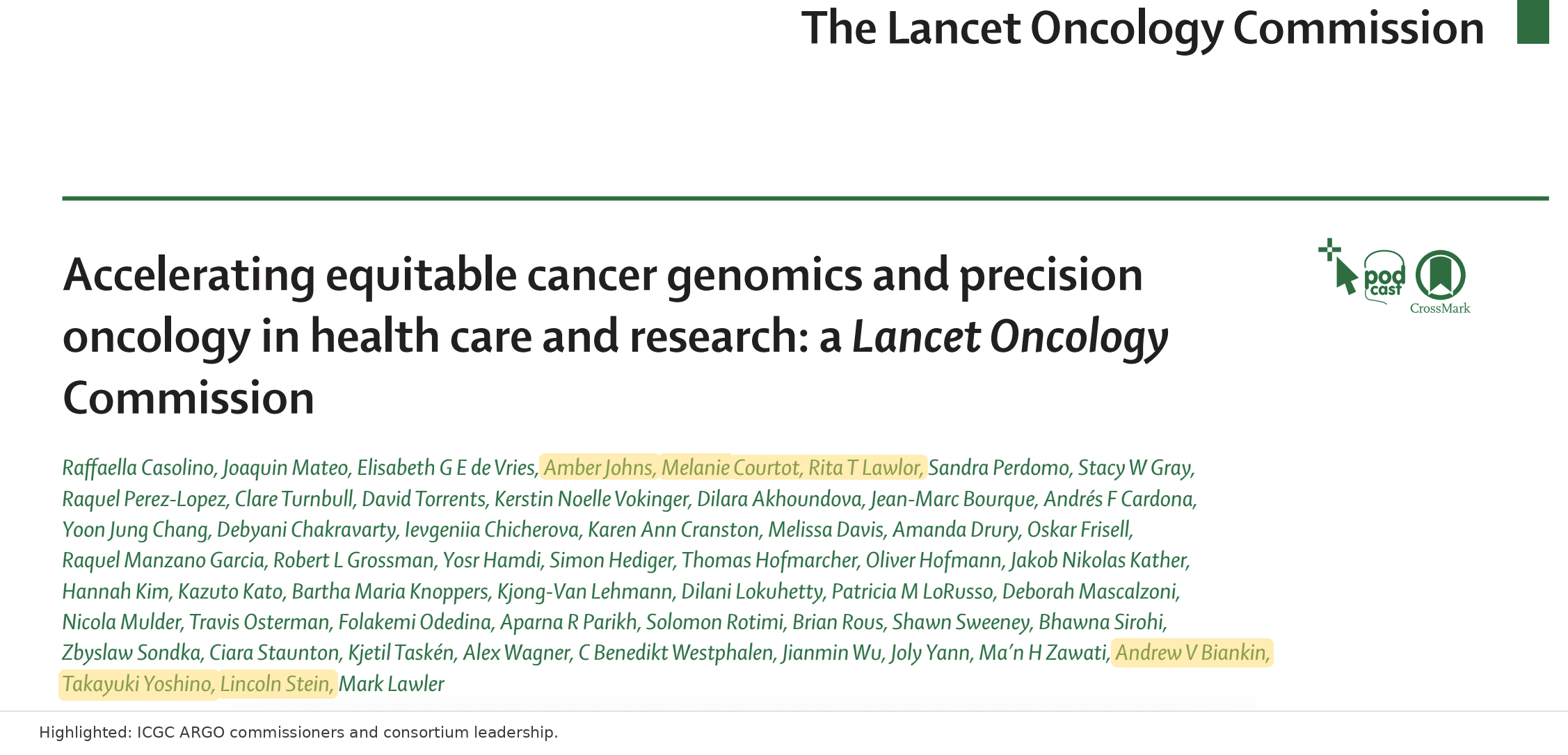
Global cancer consortium data central to Lancet Oncology Commission on equitable precision oncology
A Lancet Oncology Commission published today sets out what health systems must do to make cancer genomics and precision oncology equitable, effective and worth their cost. ICGC ARGO, the international consortium coordinating cancer genomics across 17 countries, led several of the Commission's sections.
The Commission, Accelerating equitable cancer genomics and precision oncology in health care and research, is co-chaired by Raffaella Casolino at the University of Glasgow and Mark Lawler at Queen's University Belfast. ICGC ARGO contributed throughout, across data, ethics and regulation and patient engagement. Commissioners from the consortium's leadership included Amber Johns, Rita Lawlor, Andrew Biankin, Melanie Courtot, Lincoln Stein and Takayuki Yoshino.
What the Commission found
Genomics has advanced at extraordinary speed. Yet alongside this remarkable scientific progress, a second story is unfolding: a widening inequity in who is able to benefit from these advances.
The Commission defines the current global precision oncology landscape in unparallelled detail, generating new intelligence to identify scientific, structural, and health-system challenges that compromise genomics and precision oncology globally. Convening expertise in oncology, genomics, pathology, public health, health policy, economics, data science, ethics and patient advocacy, the Commission is the most comprehensive evaluation of precision oncology ever undertaken.
The Commission found that the majority of health systems around the world are unable to effectively deliver high-quality cancer care, as life-changing molecular testing and precision oncology treatments are only available in the wealthiest countries, and even then, often only in certain well-resourced areas.
In parallel, the research and data ecosystems underpinning precision oncology remain deeply unequal, fragmented and insufficiently representative, with genomic research, biomarker-driven clinical trials and health data disproportionately concentrated in high-income countries and Western populations.
Key levers have been developed by the Commission to empower implementation. A value-based resource-stratified implementation framework; a system-readiness assessment tool; a precision oncology workforce competency-based framework; and a precision oncology monitoring and evaluation framework.
Takayuki Yoshino, Executive Director of ICGC ARGO said "ICGC ARGO will now operationalise the Commission’s framework across our global network. We will focus on standardised data sharing and resource-stratified implementation to dismantle health-system inequities, ensuring life-changing precision oncology effectively benefits every patient worldwide."
Read the Lancet Oncology Commission article here
The role of global consortium and international collaboration
The Commission stresses that reforming healthcare delivery will not be enough. Health systems also need the infrastructure and capability to use data effectively, learning from real-world evidence to improve how precision oncology is delivered and where it creates the greatest value.
Today, cancer data is fragmented and difficult to share and reuse across institutions and borders. The Commission calls for sustained investment in secure data infrastructure, supported by strong privacy protections, clear governance, responsible data sharing, and meaningful involvement of patients and the public.
The Commission points to multinational consortia as the main route by which countries outside the wealthiest systems have contributed to cancer genomics, and notes that participation builds sequencing, bioinformatics and governance capacity locally. That model depends on holding clinical, research, bioinformatics, legal, ethical and regulatory expertise alongside patient advocacy in one standing structure, so it can respond to regulatory, scientific or technological change as a single body. ICGC ARGO has operated this way across member countries since 2008.
Principles into practice
The Commission's recommendations reflect principles ICGC has worked to from the beginning. Harmonised data standards and interoperability across genomic and clinical data are central to how the consortium operates. ICGC also runs a transparent, accountable route to data access through a single compliance pathway.
The consortium is working to widen participation further, and expanding into under-represented regions is ICGC's stated next phase. That work is getting harder. The Commission's analysis, drawing on ICGC ARGO's own data, found that in 2025, 65 of 220 ICGC ARGO data access applications could not progress, and that two thirds of ARGO programmes surveyed across 23 countries reported legal or regulatory restrictions on sharing genomic data internationally.
*Takayuki Yoshino is the Professor of Global Center of Research Excellence on Advanced Medicine (G-CoRE) at Keio University School of Medicine, and Director of the Department of Global Oncology at National Cancer Center East Japan.
For further details contact us at admin@icgc-argo.org