Mutographs: reading the geography of cancer causation
Cancer incidence varies enormously between countries, and known risk factors explain only part of it. Mutographs turned that epidemiological puzzle into a genomic one.
The programme
Mutographs holds one of the original Cancer Research UK Grand Challenge awards, led by teams in the UK, France and USA. Over seven years, Mutographs set out to sequence whole genomes from 5,000 people with cancer across five continents. Five tumour types were in scope at the start: colorectal, renal, pancreatic, oesophageal adenocarcinoma and oesophageal squamous cell carcinoma (1). The study grew beyond that. Head and neck cancer was added as a sixth type, and those genomes are available in ARGO alongside other Mutographs data. Recruitment runs through dozens of hospitals and tumour banks in Europe, Asia, Africa and the Americas, supported by a centralised IARC pathology and DNA pipeline. (2)
What the genomes showed
Oesophageal squamous cell carcinoma came first. Across 552 genomes from eight countries, no signature explained the incidence gradient. (3) APOBEC signatures appeared in around 90 percent of cases.
Kidney cancer gave a sharper result. Across 962 clear cell renal cell carcinomas from 11 countries, aristolochic acid signatures dominated cases from Romania, Serbia and Thailand. (4) A signature of unknown cause appeared in more than 70 percent of Japanese cases and under 2 percent everywhere else.
Colorectal cancer reached a live clinical problem. In 981 genomes from 11 countries, the colibactin signatures SBS88 and ID18 were 3.3 times more common in people diagnosed before 40 than after 70, and appeared early in tumour development. (5) Early-life exposure to colibactin-producing bacteria is now a plausible contributor to rising early-onset disease.
Data in ARGO
Mutographs (MUTO-INTL) has submitted close to 2,700 donors since its first submission in March 2024, including 1,218 in Data Release 14.0 in March 2026. Sequencing was carried out at the Wellcome Sanger Institute. Uniformly processed genomes from four continents are now available to researchers worldwide.
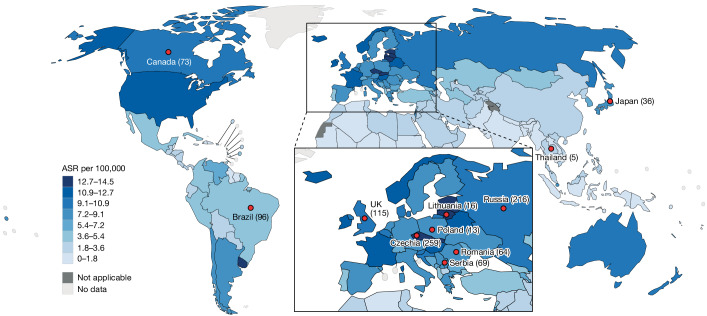
Eleven countries contributed to the Mutographs kidney cancer study, mapped here over global incidence of clear cell renal cell carcinoma. Figure 1 from Senkin S, Moody S, Díaz-Gay M, et al. Geographic variation of mutagenic exposures in kidney cancer genomes. Nature. 2024;629(8013):910-18. doi:10.1038/s41586-024-07368-2.
Browse the mutographs dataBuilt on shared data
The Wellcome Sanger Institute has been central to ICGC since the consortium's formation. The 2010 paper that launched the consortium committed to 25,000 cancer genomes across 50 tumour types, coordinated so that data from any one country could be compared against any other. (6) Wellcome Sanger led a pooled analysis of 560 breast cancer genomes identified 93 driver genes and twelve base substitution signatures. (7) PCAWG then combined 2,658 genomes from ICGC and The Cancer Genome Atlas across 38 tumour types, an analysis only a consortium could run. (8)
ICGC ARGO is proud to host the Mutographs data and to be united by data sharing.
More about Mutographs
References
1. Perdomo S, Abedi-Ardekani B, de Carvalho AC, et al. The Mutographs biorepository: a unique genomic resource to study cancer around the world. Cell Genom. 2024;4(3):100500. doi:10.1016/j.xgen.2024.100500
2. Abedi-Ardekani B, Nikmanesh A, Sotoudeh M, et al. Centralized processing of frozen tumor tissues for global cancer genomics. Nat Protoc. 2026. doi:10.1038/s41596-026-01426-x
3. Moody S, Senkin S, Islam SMA, et al. Mutational signatures in esophageal squamous cell carcinoma from eight countries with varying incidence. Nat Genet. 2021;53(11):1553-63. doi:10.1038/s41588-021-00928-6
4. Senkin S, Moody S, Díaz-Gay M, et al. Geographic variation of mutagenic exposures in kidney cancer genomes. Nature. 2024;629(8013):910-18. doi:10.1038/s41586-024-07368-2
5. Díaz-Gay M, Dos Santos W, Moody S, et al. Geographic and age variations in mutational processes in colorectal cancer. Nature. 2025;643(8070):230-40. doi:10.1038/s41586-025-09025-8
6. International Cancer Genome Consortium. International network of cancer genome projects. Nature. 2010;464(7291):993-8. doi:10.1038/nature08987
7. Nik-Zainal S, Davies H, Staaf J, et al. Landscape of somatic mutations in 560 breast cancer whole-genome sequences. Nature. 2016;534(7605):47-54. doi:10.1038/nature17676
8. ICGC/TCGA Pan-Cancer Analysis of Whole Genomes Consortium. Pan-cancer analysis of whole genomes. Nature. 2020;578(7793):82-93. doi:10.1038/s41586-020-1969-6